Saturday, 28 June 2014

CIDR Notation

Inside the computer each address mask is stored as a 32 bit value in binary, which is then expressed in dotted octet notation.
The new CIDR notation append a slash and the size of the mask in decimal notation:

       For example 128.10.0.0/16
CIDR Address Block Example
Suppose an ISP has a single Class B license 128.211.00.0.  Using a classful address scheme, he/she can only assign the prefix to one customer, who can have up to 216 host addresses.
Using CIDR, the ISP could assign the entire prefix to a single organization by using 128.211.0.0/16
Or he could partition the address into three pieces (two of them big enough for 2 customers with 12 computers each and the remainder available for future use.
One customer could be assigned 128.211.0.16/28
and the other could be assigned  128.211.0.32/28
Both customers have the same mask size (28 bits), but the prefixes differ and each has a unique prefix.  More importantly the ISP retains most of the addresses, which can then be assigned to other customers.

Routers and Addresses

•Routers compare the network prefix portion of the address to a value in their routing tables.
•Suppose a router is given a destination address, D and a pair (A,M) that 
represents the 32 bit address and the 32 bit subnet mask.
•To make the comparison, the router tests the logical "and" condition to set 
the host bits of address D to zero and then compares the result with the network prefix A:

  A == ( D & M)
•For example consider this 32 bit mask: 
  (255.255.0.0 in decimal)
11111111 11111111 00000000 00000000
  and the network prefix (128.10.0.0 in decimal):
10000000 00001010 00000000 00000000
•Now consider the 32 bit destination address
 128.10.2.3 which has the binary equivalent of
10000000 00001010 00000010 00000011
•The logical "and" between the destination address and the address mask
 produces the result:
10000000 00001010 00000000 00000000
•which is equal to the prefix 128.10.0.0

Address Masks in Networks

How can an IP address be divided at an arbitrary boundary?

It requires an additional piece of information to be stored with each address. This information specifies the exact boundary between the network prefix and the host suffix.
To use classless or subnet addressing the routers must store 2 pieces of information:
the 32 bit address and
another 32 bit value that specifies the boundary between the prefix and suffix.
This second value is called the called the subnet mask and 1 bits mark the network prefix and zero bits mark the host portion. This makes computation efficient.

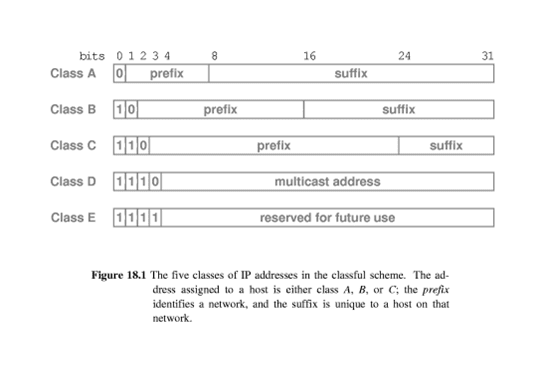
IP Address Classes

IP Address Classes

IP Addressing


IP Addressing

·  Octet (8-bit) boundaries  are used to 

partition an address into prefix and suffix

·  Class A, B and C are primary classes

·  Used for ordinary host addressing

·  Class D is used for multicast, a limited 

form of broadcast

·  Internet hosts join a multicast group

·  Packets are delivered to all members of 

group

·  Routers manage delivery of single packet


 from source to all members of multicast

 group

·  Used for MBone (multicast backbone)

·  Class E is reserved ( for future use)

·  IP software computes the class of the destination address when it receives a packet.
·  IP addresses are self-identifying because the class can be computed directly from the first few bits of the address
· The first 4 (leading) bits of the address denote the class:
–Class A begins with 0
–Class B begins with 10
–Class C begins with  110


difference between circuit-switched and packet-switched networks?

Packet Switching:
ØIn packet-based networks,  the message gets broken into small data packets. 
ØThese packets are sent out from the computer and they travel around the network seeking out the most efficient route to travel as circuits become available. 
ØThis does not necessarily mean that they seek out the shortest route.

ØEach packet may go a different route from the others

Advantages:

  •   Security
  •   Bandwidth used to full potential
  •  Devices of different speeds can communicate
  •   Not affected by line failure (redirects signal)
  •   Availability – no waiting for a direct connection to become available
  •   During a crisis or disaster, when the public telephone network might stop working, e-mails and texts can still be sent via packet switching
Disadvantages
»Under heavy use there can be a delay
»Data packets can get lost or become corrupted
»Protocols are needed for a reliable transfer
»Not so good for some types data streams (e.g. real-time video streams can lose frames due to the way packets arrive out of sequence)

Circuit Switching:
 ØCircuit switching was designed in 1878 in order to send telephone calls down a dedicated channel. 
ØThis channel remains open and in use throughout the whole call and cannot be used by any other data or phone calls.

Advantages

»Circuit is dedicated to the call – 
no interference, no sharing

»Guaranteed the full bandwidth
 for the duration of the call

»Guaranteed quality of service
Disadvantages

»Inefficient – the equipment may be 
unused for a lot of the call; if no data is 
being sent, the dedicated line still 
remains open.

»It takes a relatively long time to set up
 the circuit.

»During a crisis or disaster, the network 
may become unstable or unavailable.
»It was primarily developed for voice 

traffic rather than data traffic.

Tuesday, 14 August 2012

Different types of switching techniques

Different types of switching techniques are employed to provide communication between two computers. These are : Circuit switching, message switching and packet switching.
Circuit Switching
In this technique, first the complete physical connection between two computers is established and then data are transmitted from the source computer to the destination computer. That is, when a computer places a telephone call, the switching equipment within the telephone system seeks out a physical copper path all the way from sender telephone to the receiver’s telephone. The important property of this switching technique is to setup an end-to-end path (connection) between computer before any data can be sent.
Message Switching
In this technique, the source computer sends data or the message to the switching office first, which stores the data in its buffer. It then looks for a free link to another switching office and then sends the data to this office. This process is continued until the data are delivered to the destination computers. Owing to its working principle, it is also known as store and forward. That is, store first (in switching office), forward later, one jump at a time.
Packet Switching
With message switching, there is no limit on block size, in contrast, packet switching places a tight upper limit on block size. A fixed size of packet which can be transmitted across the network is specified. Another point of its difference from message switching is that data packets are stored on the disk in message switching whereas in packet switching, all the packets of fixed size are stored in main memory. This improves the performance as the access time (time taken to access a data packet) is reduced, thus, the throughput (measure of performance) of the network is improved

Switching Techniques


Switching Techniques - In large networks there might be multiple paths linking sender and receiver. Information may be switched as it travels through various communication channels. There are four typical switching techniques available for digital traffic.
    * Circuit Switching
    * Packet Switching
    * Message Switching
    * Cell Switching
Circuit Switching
         Circuit switching is a technique that directly connects the sender and the receiver in an unbroken path.
         Telephone switching equipment, for example, establishes a path that connects the caller's telephone to the receiver's telephone by making a physical connection.
         With this type of switching technique, once a connection is established, a dedicated path exists between both ends until the connection is terminated.
         Routing decisions must be made when the circuit is first established, but there are no decisions made after that time
         Circuit switching in a network operates almost the same way as the telephone system works.
         A complete end-to-end path must exist before communication can take place.
         The computer initiating the data transfer must ask for a connection to the destination.
         Once the connection has been initiated and completed to the destination device, the destination device must acknowledge that it is ready and willing to carry on a transfer.
Advantages:
          The communication channel (once established) is dedicated.


Disadvantages:
           Possible long wait to establish a connection, (10 seconds, more on  long- distance or international calls.) during which no data can be transmitted.
           More expensive than any other switching techniques, because a dedicated path is required for each connection.
           Inefficient use of the communication channel, because the channel is not used when the connected systems are not using it.
Packet Switching
* Packet switching can be seen as a solution that tries to combine the advantages of message and circuit switching and to minimize the disadvantages of both
* There are two methods of packet switching: Datagram and virtual circuit.
* In both packet switching methods, a message is broken into small parts, called packets.
* Each packet is tagged with appropriate source and destination addresses.
* Since packets have a strictly defined maximum length, they can be stored in main memory instead of disk; therefore access delay and cost are minimized.
* Also the transmission speeds, between nodes, are optimized.
* With current technology, packets are generally accepted onto the network on a first-come, first-served basis. If the network becomes overloaded, packets are delayed or discarded (``dropped'').
The size of the packet can vary from 180 bits, the size for the Datakit virtual circuit switch designed by Bell Labs for communications and business applications; to 1,024 or 2,048 bits for the 1PSS switch, also designed by Bell Labs for public data networking; to 53 bytes for ATM switching, such as Lucent Technologies' packet switches
* In packet switching, the analog signal from your phone is converted into a digital data stream. That series of digital bits is then divided into relatively tiny clusters of bits, called packets. Each packet has at its beginning the digital address -- a long number -- to which it is being sent. The system blasts out all those tiny packets, as fast as it can, and they travel across the nation's digital backbone systems to their destination: the telephone, or rather the telephone system, of the person you're calling.
* They do not necessarily travel together; they do not travel sequentially. They don't even all travel via the same route.
But eventually they arrive at the right point -- that digital address added to the front of each string of digital data -- and at their destination are reassembled into the correct order, then converted to analog form, so your friend can understand what you're saying.
* Datagram packet switching is similar to message switching in that each packet is a self-contained unit with complete addressing information attached.
* This fact allows packets to take a variety of possible paths through the network.
* So the packets, each with the same destination address, do not follow the same route, and they may arrive out of sequence at the exit point node (or the destination).
* Reordering is done at the destination point based on the sequence number of the packets.
* It is possible for a packet to be destroyed if one of the nodes on its way is crashed momentarily. Thus all its queued packets may be lost.
* In the virtual circuit approach, a preplanned route is established before any data packets are sent.
* A logical connection is established when a sender send a "call request packet" to the receiver and the receiver send back an acknowledge packet "call accepted packet" to the sender if the receiver agrees on conversational parameters.
• The conversational parameters can be maximum packet sizes, path to be taken, and other variables necessary to establish and maintain the conversation.
• Virtual circuits imply acknowledgements, flow control, and error control, so virtual circuits are reliable. That is, they have the capability to inform upper-protocol layers if a transmission problem occurs
• In virtual circuit, the route between stations does not mean that this is a dedicated path, as in circuit switching.
* A packet is still buffered at each node and queued for output over a line.
The difference between virtual circuit and datagram approaches:
* With virtual circuit, the node does not need to make a routing decision for each packet.
* It is made only once for all packets using that virtual circuit. VC's offer guarantees that the packets sent arrive in the order sent with no duplicates or omissions with no errors (with high probability) regardless of how they are implemented internally
Advantages:
• Packet switching is cost effective, because switching devices do not need massive amount of secondary storage.
• Packet switching offers improved delay characteristics, because there are no    long messages in the queue (maximum packet size is fixed).
• Packet can be rerouted if there is any problem, such as, busy or disabled links.
* The advantage of packet switching is that many network users can share the same channel at the same time. Packet switching  can maximize link efficiency by making optimal use of link bandwidth.
Disadvantages:
• Protocols for packet switching are typically more complex.
• It can add some initial costs in implementation.
• If packet is lost, sender needs to retransmit the data. Another disadvantage is that packet-switched systems still can’t deliver the same quality as dedicated circuits in applications requiring very little delay - like voice conversations or   moving images.
Message Switching
         With message switching there is no need to establish a dedicated path between two stations.
         When a station sends a message, the destination address is appended to the message.
         The message is then transmitted through the network, in its entirety, from node to node.
         Each node receives the entire message, stores it in its entirety on disk, and then transmits the message to the next node.
         This type of network is called a store-and-forward network.
A message-switching node is typically a general-purpose computer. The device needs sufficient secondary-storage capacity to store the incoming messages, which could be long. A time delay is introduced using this type of scheme due to store- and-forward time, plus the time required to find the next node in the transmission path.
Advantages:
            Channel efficiency can be greater compared to circuit-switched systems, because more devices are sharing the channel.
           Traffic congestion can be reduced, because messages may be
 temporarily stored in route.
           Message priorities can be established due to store-and-forward
   technique.
           Message broadcasting can be achieved with the use of
   broadcast address appended in the message
Disadvantages
            Message switching is not compatible with interactive
    applications.
            Store-and-forward devices are expensive, because they 
    must have large disks to hold potentially long messages
Cell Switching
Cell Switching is similar to packet switching, except that the switching does not necessarily occur on packet boundaries. This is ideal for an integrated environment and is found within Cell-based networks, such as ATM. Cell-switching can handle both digital voice and data signals.

Monday, 30 July 2012

Line Coding: Polar

Line Coding: Polar 7

Polar Line Coding – uses two non-zero voltage level for represent.
of two data levels - one positive & one negative
  • • “DC-problem” alleviated
  • • 4 main types of polar coding:
 

in NRZ there are two types :NRZ-level   NRZ-invert
(1) Nonreturn to Zero
(NRZ)
  • • NRZ-level: signal level represents particular
  • bit, (e.g.) 0 = positive volt. , 1 = negative volt.
  •  poor synchronizat. for long series of 1-s & 0-s 
  • • NRZ-invert: inversion of voltage level = bit 1,
    no voltage = bit 0
  • 1s in data streams enable synchronization
  •  long sequence of 0-s still a problem

Line Coding: Unipolar

Line Coding: Unipolar 6
Unipolar Line Coding – uses only one non-zero and one zero
voltage level
• (e.g.) 0 = zero level, 1 = non-zero level
• simple to implement, but obsolete due to
two main problems:
  •  DC component present 
  •  lack of synchronization for long series of 1-s or